New Mobile Site
We have just launched a new mobile version of this site - m.trainspots. This page will use your smart device's GPS to loctate you and guide you to locations that are close to your present location.
Location notes
About 2 miles south of the village of Wickwar in Gloucestershire, on the former Midland route between Bristol and Gloucester.
Railway type and traffic
Passenger traffic consists of Cross Country class 220 and 221 (Voyager) sets and FGW class 143, 150, 153 and 158 DMUs on local services.
Freight includes Class 66-hauled coal from Portbury to the Midlands and Class 60s on 'Murco' bogie fuel tanks for the nearby Westerleigh terminal.
When the Severn Tunnel is closed for maintenance, FGW HSTs on London-South Wales services use this route to cross the Severn at Gloucester.
Steel traffic may also be seen on weekend diversions.
Freight includes Class 66-hauled coal from Portbury to the Midlands and Class 60s on 'Murco' bogie fuel tanks for the nearby Westerleigh terminal.
When the Severn Tunnel is closed for maintenance, FGW HSTs on London-South Wales services use this route to cross the Severn at Gloucester.
Steel traffic may also be seen on weekend diversions.
Environment
The location is an over bridge on a relatively quiet country lane favoured by local horse-riders, joggers and cyclists. This is a safe and pleasant rural location, where one can often watch buzzards and smaller birds between trains.
Road directions
The location is best reached from the B4060 between Chipping Sodbury and Wickwar. Take the first turning on the right heading south from Wickwar towards Hall End. The lane descends through a leafy cutting, after
which you should turn right to reach the railway bridge.
Click here to set up your location for directions to this location
Wickwar south map co-ordinates
Click here to set up your location for directions to this location
Wickwar south map co-ordinates
Parking
Parking is possible on the verge close to the bridge, or by the gate giving access to the line for PW workers, who may of course turn up and ask you to move your vehicle so they can get in!
Public transport
There is no public transport to the location and it is a fair hike from the nearest bus routes at Chipping Sodbury or Wickwar.
Click here to set up your location for directions to this location
Click here to set up your location for directions to this location
Amenities
There are no amenities at the location but there are pubs and shops in both Wickwar and Chipping Sodbury. It is best to take a supplies, particularly if going for the 'Murcos', as unpredictable running can result in a long wait!
Accommodation
Accommodation is available in Chipping Sodbury and Wickwar, or further afield in Bristol and Bath.
Sun Compass
Sun Compass using Suncalc by brought to you by Vladimir Agafonkin:
It might be necessary to adjust the time to suit your visit, this link should open with the current day.
Wickwar south
Streetmap links
Wickwar south general view map
Wickwar south close up map
Windows Local Live Link - image quality may vary
Wickwar south
It might be necessary to adjust the time to suit your visit, this link should open with the current day.
Wickwar south
Googly map
Wickwar south general view map
Wickwar south close up map
Windows Local Live Link - image quality may vary
Wickwar south
Who likes this location on facebook
Railway Gen Group
Photographic notes
The road bridge is best for south-bound traffic emerging from Wickwar Tunnel. The summit of the line, which is approximatley 1.5 miles south of the tunnel, so steam locos may 'shut off' before reaching the location.
The light is ok from mid-morning until early afternoon (when the sun becomes 'head-on') and then again from mid- or late afternoon from the western side of the line.
During winter, the cutting can be shadowy for much of the day.
By crossing the style and walking along the footpath that parallels the line on the east side, one can reach the small footbridge over the railway from which it is possible to photograph trains in the rock cutting immediately after leaving the tunnel. The footbridge also provides a good location for northbound trains.
It is also possible to obtain good panoramic shots, or videos, of northbound trains from the hill above the tunnel mouth, reachable from the same footpath.
Another option is to drive a short distance to Hall End bridge a little further south, which offers afternoon shots in both directions, subject to tree growth!
The light is ok from mid-morning until early afternoon (when the sun becomes 'head-on') and then again from mid- or late afternoon from the western side of the line.
During winter, the cutting can be shadowy for much of the day.
By crossing the style and walking along the footpath that parallels the line on the east side, one can reach the small footbridge over the railway from which it is possible to photograph trains in the rock cutting immediately after leaving the tunnel. The footbridge also provides a good location for northbound trains.
It is also possible to obtain good panoramic shots, or videos, of northbound trains from the hill above the tunnel mouth, reachable from the same footpath.
Another option is to drive a short distance to Hall End bridge a little further south, which offers afternoon shots in both directions, subject to tree growth!
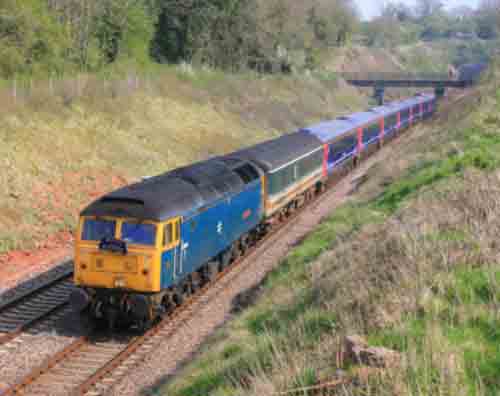
General views - All photographs © Glen Batten unless otherwise stated
Fig 1 - Looking north east
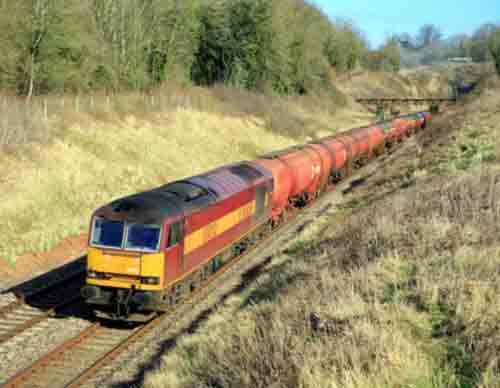
Fig 2 - Looking north east
Disclaimer
All information contained within this is site is © Trainspots. The images used on this site remain the property of the original photographer, as credited at the top of the page, and are used with their kind permission.
The information on these pages is supplied for the benefit of railway enthusiasts who carry out a harmless hobby, and through the medium of photography and video, actually promote the railway industry. Railway enthusiasts can also act as eyes and ears against railway vandalism, and as such should surely be encouraged to do so by the supply of adequate information such as is found on this website.
This site has been created to assist railway photographers in their travels around the country. It is based on the personal knowledge and experience. No liability can be held against the web site or its contributions for incorrect information. Trainspots will endeavour to check all information and corrections will be accepted and posted accordingly.
Advice as to the locations general environment is given as a guide on each page. This information is a GUIDE only. ALWAYS be careful with your equipment, Trainspots can not be held responsible for your personal security. Avoid leaving your property on display for all to see, be aware of your surroundings at all times. There are, sadly, people who will not think twice about trying to steal your equipment.
Trainspots DOES NOT condone trespass and none of the information on this site should be taken as a right to trespass on either railway or private land. To the best of our knowledge all locations are publicly accessible areas, where they are not contact information will be given to the appropriate authority for permission to be obtained.
The content of this site is created and intended for all age ranges but the content of sites linked from this site are not subject to the same intentions. Trainspots will attempt to check links for validity but as time passes and the site grows this will not always be possible. Broken, or indeed updates to, links should be submitted to the editor for inclusion in the updates. All links external to the Trainspots site are opened in a new browser window. Trainspots has been running now for over 10 years and there are imitation sites and guides to railfotspots. But we are a free site and we continue on the path we started out on over a decade ago to provide a useful guide to UK Railway Photographic Locations.
The information on these pages is supplied for the benefit of railway enthusiasts who carry out a harmless hobby, and through the medium of photography and video, actually promote the railway industry. Railway enthusiasts can also act as eyes and ears against railway vandalism, and as such should surely be encouraged to do so by the supply of adequate information such as is found on this website.
This site has been created to assist railway photographers in their travels around the country. It is based on the personal knowledge and experience. No liability can be held against the web site or its contributions for incorrect information. Trainspots will endeavour to check all information and corrections will be accepted and posted accordingly.
Advice as to the locations general environment is given as a guide on each page. This information is a GUIDE only. ALWAYS be careful with your equipment, Trainspots can not be held responsible for your personal security. Avoid leaving your property on display for all to see, be aware of your surroundings at all times. There are, sadly, people who will not think twice about trying to steal your equipment.
Trainspots DOES NOT condone trespass and none of the information on this site should be taken as a right to trespass on either railway or private land. To the best of our knowledge all locations are publicly accessible areas, where they are not contact information will be given to the appropriate authority for permission to be obtained.
The content of this site is created and intended for all age ranges but the content of sites linked from this site are not subject to the same intentions. Trainspots will attempt to check links for validity but as time passes and the site grows this will not always be possible. Broken, or indeed updates to, links should be submitted to the editor for inclusion in the updates. All links external to the Trainspots site are opened in a new browser window. Trainspots has been running now for over 10 years and there are imitation sites and guides to railfotspots. But we are a free site and we continue on the path we started out on over a decade ago to provide a useful guide to UK Railway Photographic Locations.